

- Home
- > Expert Insight
- > Conductor design
- > CIGRE Panel Session – Episode 4 : Addressing noise legislation: how can composite core conductors reduce corona effects?
CIGRE Panel Session – Episode 4 : Addressing noise legislation: how can composite core conductors reduce corona effects?
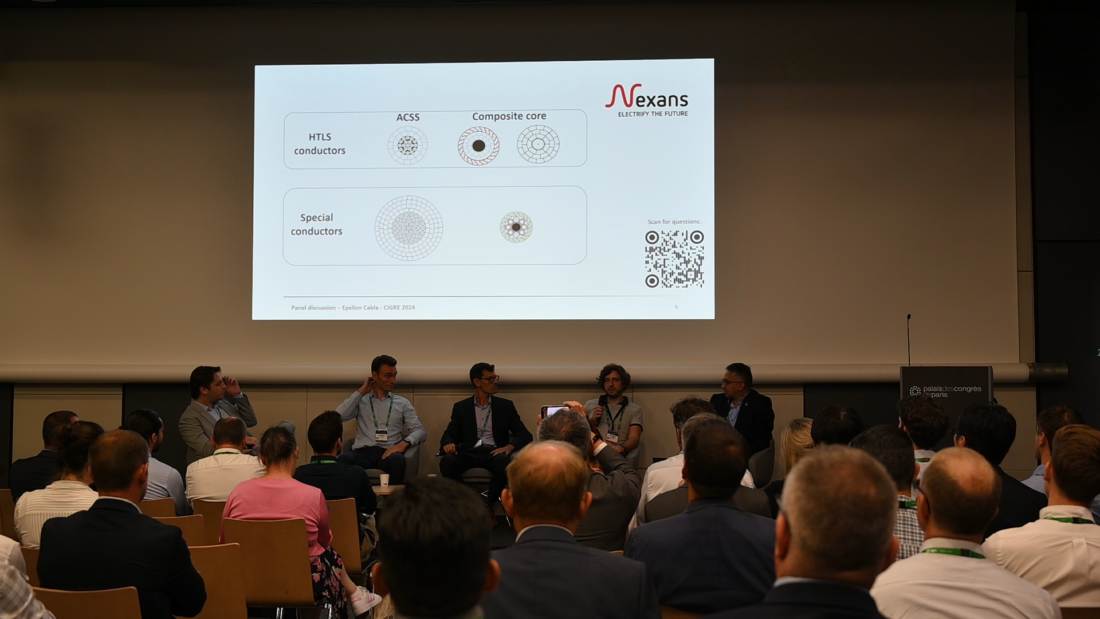
During the last CIGRE Paris Session, Epsilon Cable organized a panel discussion bringing together experts from utilities, engineering firms and manufacturers to exchange insights on composite core conductors. The event was fully booked, with around one hundred CIGRE delegates and guests, highlighting the strong interest in this technology across the transmission community.
In this series of articles, we share key highlights from the event with a wider audience, in line with CIGRE’s mission to promote knowledge sharing and best practices within the electrical transmission industry.
The first expert panel featured:
- Erwin Platenkamp (TenneT)
- Jérémy Unterfinger (Amprion GmbH)
- Maxime Delbove (Nexans)
- Vivendra Naidoo (EFLA Consulting Engineers)
In this fourth episode, we explore the perspectives of a TSO (Amprion) and a manufacturer (Nexans) on noise-related legislation, and how composite core conductors help reduce corona effect.
The session was moderated by Joseph Sylvia from Epsilon Composite.

Joseph: Germany has laws associated with corona noise. Could you tell us a little bit about what you implemented to comply with such regulations?
Jeremy: Our region has a high population density. When replacing old conductors that have accumulated oxidation and pollution. Ten to twelve years ago, we had to stop installing new conductors and develop new technologies. We started with surface treatments, which helped but were not sufficient. We then improved the organization of our conductors in the bundle, reducing spacing from 400m to 300m, but that still was not enough. That is why we introduced a core with very low weight, allowing us to create new designs and increase the conductor diameter while keeping the same load on the towers. A larger diameter improves the surface electric field distribution, which helps reduce corona effects.
Joseph: Can you explain the main design choices behind this “special” low-noise conductor and the benefits they deliver?
Maxime: The carbon core was definitely the key element. It provides good mechanical performance and low thermal elongation. In terms of equivalent weight, some parts initially made of steel could be replaced with aluminum, which also decreases electrical resistance.
Another advantage is that the conductor can operate at higher temperatures, offering increased capacity if needed, even if this is not the primary purpose.
As Jeremy mentioned, the first goal of the design was to have a smooth surface. Using a compact conductor design was essential to achieve the best possible surface gradient. Nevertheless, that alone was not sufficient. It is combined with a surface treatment, to provide specific surface properties and reduce noise, particularly after rainfall.
The third key point was to make an expending conductor. Because the gradient was already near the limit, the design was sensitive. Increasing the diameter was necessary to meet the noise levels required by Amprion. By incorporating tubes inside, the idea was to maintain the same weight while increasing the diameter. Another benefit of the outer surface design is that it minimizes drag, which ensures compatibility with the existing towers.
Joseph: What changes were required in terms of manufacturing and installation for this conductor?
Maxime: Regarding production and installation, there is essentially no difference. The conductor is produced on the same machines, using the same methodology. It requires a little extra care because it is slightly more sensitive, but once operators are experienced, standard installation methods and accessories for composite cores can be used. There are minor adjustments, but overall, the methodology remains the same.
Question from the audience: Has this special low-noise conductor been tested for corona in a twin bundle or a triple bundle configuration?
Jeremy: For 380 kV at Amprion, we use a 4-bundle configuration with 4 mm spacing between conductors. We conducted extensive tests in collaboration with the University of Graz. Our calculations indicated that, for 380 kV, due to the electrical configuration of our towers, a spacing of 400 mm is not optimal. In fact, the better approach is not to increase the spacing but to reduce it.
The optimal distance between the four conductors is around 280 mm, so we rounded it to 300 mm. We use this configuration only when necessary, which is why we developed this low-weight conductor. Initially, we had 22.4 mm, and we increased it to 25.9 mm. This significantly reduces the surface gradient, lowering corona effects by about 5 dB overall. We specifically used the compact bundle conductor in these tests.