


This collection brings together technical papers and institutional publications addressing advanced conductors, composite core technologies, grid modernization, materials science and conductor monitoring. Published through recognized industry, scientific and technical organizations such as CIGRE, CIRED, Energy Institute at Haas Berkely and CurrENT, these works include contributions from Epsilon Cable experts as authors or co-authors, sharing research results, field experience and technical perspectives developed in collaboration with the wider power transmission community.
Dielectric assessment of composite core conductors: impact and return of experience from a field deployment
CIGRE Paris
A complete return of experience on Corecheck methodology. The method was validated through an industrial-scale 380 kV refurbishment project in the Netherlands. It was applied from manufacturing through onsite installation, detecting surface defects below 0.3 mm and operating successfully across varied weather conditions. Field experience showed rapid testing, limited disruption to regular installation practice, straightforward crew training, and strong potential for traceability and lifecycle monitoring.
Deployment strategy of innovative grid technologies across European distribution systems
CIRED Geneva
Innovative Grid Technologies can help European Distribution System Operators increase network capacity, integrate renewable generation and respond more rapidly to evolving grid constraints. Advanced conductors, dynamic line rating, power flow control, digital twins and monitoring systems provide complementary capabilities. Effective deployment requires adapted planning methods, appropriate cost-benefit assessment, technical assurance frameworks and greater consideration of combined technology solutions.
Managing uncertainty for DSOs
CIRED Geneva
Innovative Grid Technologies (IGTs) can help Distribution System Operators manage uncertainty linked to renewable integration, permitting delays and long-term grid planning. A revised cost-benefit framework incorporating deployment speed, phased investment, redeployability and total expenditure shows that IGTs can provide flexible, economically competitive solutions, either independently or alongside conventional infrastructure, while reducing risks associated with long development timelines.
Dielectric testing for integrity assessment of overhead composite core conductors
CIGRE Paris
Corecheck, a dielectric breakdown testing, provides a non-destructive method for assessing the integrity of composite-core overhead conductors during manufacturing, stranding and field installation. Tests on cores and conductors, including artificially induced defects, showed reliable detection of structural damage. A portable field device and associated safety protocol enable rapid onsite inspection, with preparation and testing completed in under 15 minutes.
Fostering grid flexibility and renewables integration with advanced composite overhead conductors
CIGRE Electra
Advanced composite-core conductors can increase grid flexibility by enabling higher ampacity, lower sag and reduced electrical losses within existing transmission corridors. Their use in reconductoring can shorten deployment times and avoid major structural modifications. Combined with technologies such as Dynamic Line Rating, advanced power flow control and topology optimisation, they can support more efficient integration of variable renewable generation.
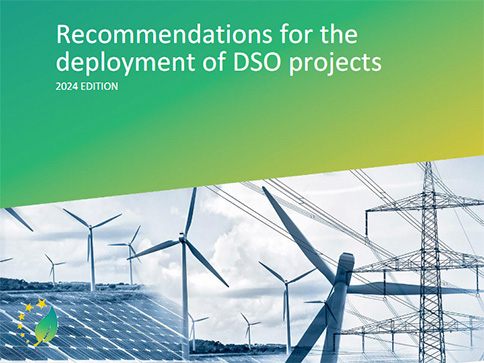
Recommendations for the deployment of DSO projects
CurrENT 2024
Mature innovative grid technologies can help Distribution System Operators increase network flexibility, reduce deployment time and make better use of existing infrastructure. Effective deployment depends on functional tender specifications, adapted cost-benefit analysis, streamlined technical assurance, shared testing evidence and appropriate regulatory support. Advanced conductors, digital twins, dynamic line rating, modular power flow control and monitoring technologies are highlighted as complementary solutions.
Accelerating transmission capacity expansion by using advanced conductors in existing right-of-way
Energy Institute at Haas Berkely
Large-scale reconductoring with advanced composite-core conductors can substantially expand transmission capacity while using existing rights-of-way. Modelling of the US power system indicates that reconductoring could meet over 80% of new interzonal transmission needs required for more than 90% clean electricity by 2035, while reducing permitting constraints and generating significant system cost savings compared with new-build transmission.
Design of alternative composite core conductors for new overhead lines
CIGRE Sendai
Alternative composite-core conductor designs are explored for lower-temperature applications, combining A1 aluminium with more cost-efficient fibre and matrix systems. The proposed design is estimated to be 50% cheaper than conventional HTLS conductors, while delivering 15% higher ampacity than ACSR and lower electrical losses. At equivalent resistance, it could reduce conductor weight by 30% and diameter by 13%, although tensile strength would be lower and require further sag analysis.
Towards a predictive model for the residual strength of polymer matrix composite core in High Temperature Low Sag conductors in function of the operating conditions
CIGRE Paris
Polymer matrix composite cores used in HTLS conductors can undergo thermal and hydrothermal ageing, affecting their long-term mechanical and physico-chemical properties. Accelerated testing and Time-Temperature Superposition modelling indicate strong thermal stability, with more than 95% residual flexural strength predicted after 30 years at 160°C. The results support development of predictive lifetime models based on operating conditions.
Contact our expert to deepen the discussion
Share your opinion about one of those publication.