


- Home
- > Expert Insight
- > Conductor installation
- > CIGRE Panel Session – Episode 6: Monitoring composite core conductor with CORECHECK
CIGRE Panel Session – Episode 6: Monitoring composite core conductor with CORECHECK
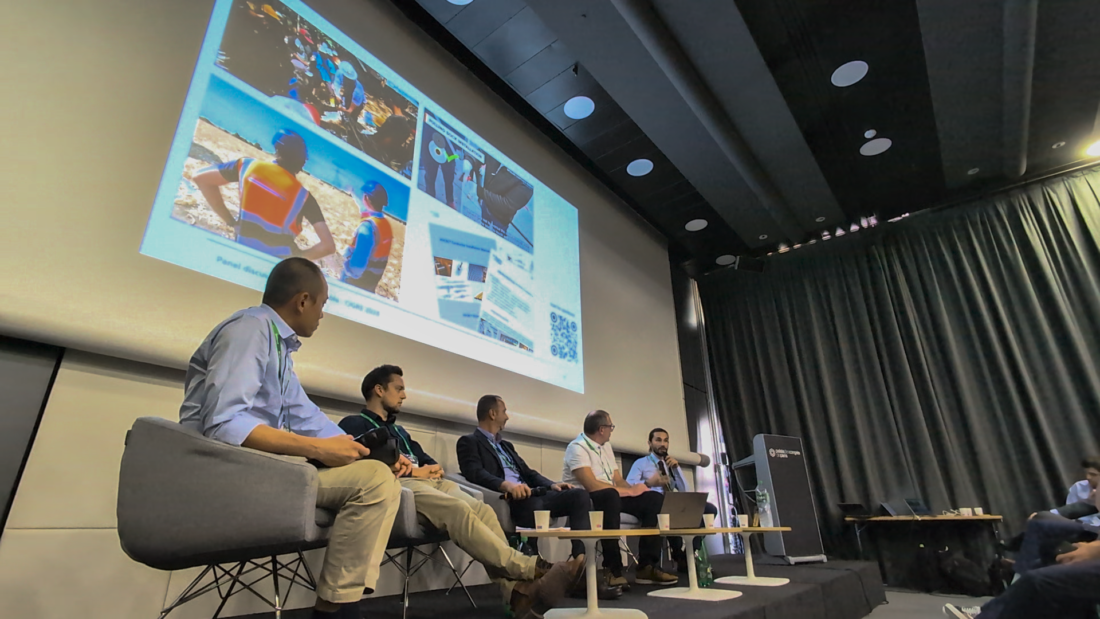
During the last CIGRE Paris Session, Epsilon Cable organized a panel discussion bringing together experts from utilities, engineering firms and manufacturers to exchange insights on composite core conductors. The event was fully booked, with around one hundred CIGRE delegates and guests, showing the strong interest this topic generates within the transmission community.
In this series of articles, we share key highlights of the event with a broader audience, in line with CIGRE’s mission to spread knowledge and best practices across the electrical transmission industry.
The first expert panel focused on line design using composite core conductors and featured:
- Tom Vanderlinden (Elia)
- Léo Richard (Epsilon Cable)
- Gianluca Cimmino (Tesmec)
- Jérôme Brocard (Sicame)
Vincent Bu from Epsilon Composite moderated the session.
In this episode, we will focus on the introduction of the CORECHECK® monitoring technology presented by Léo Richard during the event.

Vincent: Why did Epsilon decide to develop a monitoring solution for composite core conductors?
Léo: A few years ago, we decided to develop a dedicated solution for monitoring composite core conductors. At the beginning of the project, we considered several approaches. Epsilon already had strong experience in non-destructive testing for composites, particularly in aerospace, but the challenge here was to adapt or reinvent a method specifically for composite conductors.
Vincent: What technology did you choose and why?
Léo: After evaluating different options, including optical systems, we chose to develop a solution based on breakdown voltage. This approach relies on the intrinsic structure of the conductor. The composite core includes a natural insulating layer made of glass fiber, while the aluminum outer layer is highly conductive, and the carbon core also conducts electricity due to its continuous structure. From an electrical standpoint, the conductor behaves like a large capacitor.
By assessing the integrity of the glass layer, which acts as an insulator, we can detect any defects affecting the core, which is the load-bearing element of the conductor. This method provides a reliable way to evaluate the structural integrity of the product.
Vincent: What are the main advantages of CORECHECK in the field?
Léo: One of the key advantages of this solution is its simplicity. It is based on proven industrial testing methods, adapted to a new type of product. It enables full 360-degree monitoring of the core and can be applied at multiple stages: after core manufacturing, after stranding, before stinging and most importantly after installation.
For on-site use, we have developed a compact and lightweight testing kit, designed to be easy to handle by field operators. The system is safe and simple to use and does not disrupt existing installation processes. The test itself takes about 5 minutes per conductor and mainly consists of establishing electrical contact, applying the measurement, and assessing the result.
The project is currently progressing well and approaching full maturity, as this technology is being deployed in several projects across Europe. Ultimately, this technology will enhance operational safety and improve reliability throughout the value chain, ensuring better traceability and reducing the risk of defects during installation and operation.
Question from the audience: Can you explain how the CORECHECK test works in practice?
Léo: The CORECHECK system is based on breakdown voltage. In that case, you have to picture the conductor as a capacitor, we basically plug crocodile clips on the two electrodes, which are the carbon core and the aluminum layer, and then you inject power with a certain amount of voltage for a certain duration of time. If there is a failure in the composite core, electricity will be able to go through the glass fiber insultaing layer and the CORECHECK kit will detect it, giving a red light signal. If no failure is detected, the kit will provide a green light signal. In both case, a complete report will be made available.
Question from the audience: Is it dangerous to perform the CORECHECK test on a high-voltage line?
Léo: The CORECHECK test is safe to perform on high-voltage lines. The only potential risk is in the immediate vicinity of the electrodes, which is why strict procedures ensure that only one operator accesses this area at a time.
Standard grounding practices are applied throughout the test, as in any routine operation. In addition, the system has been validated to operate safely even in the presence of a live parallel line, as any induced currents are properly managed by the test equipment.