


- Home
- > Expert Insight
- > Conductor installation
- > CIGRE panel session — Episode 8: How HTLS conductors are reshaping installation tooling — Tesmec’s perspective
CIGRE panel session — Episode 8: How HTLS conductors are reshaping installation tooling — Tesmec’s perspective
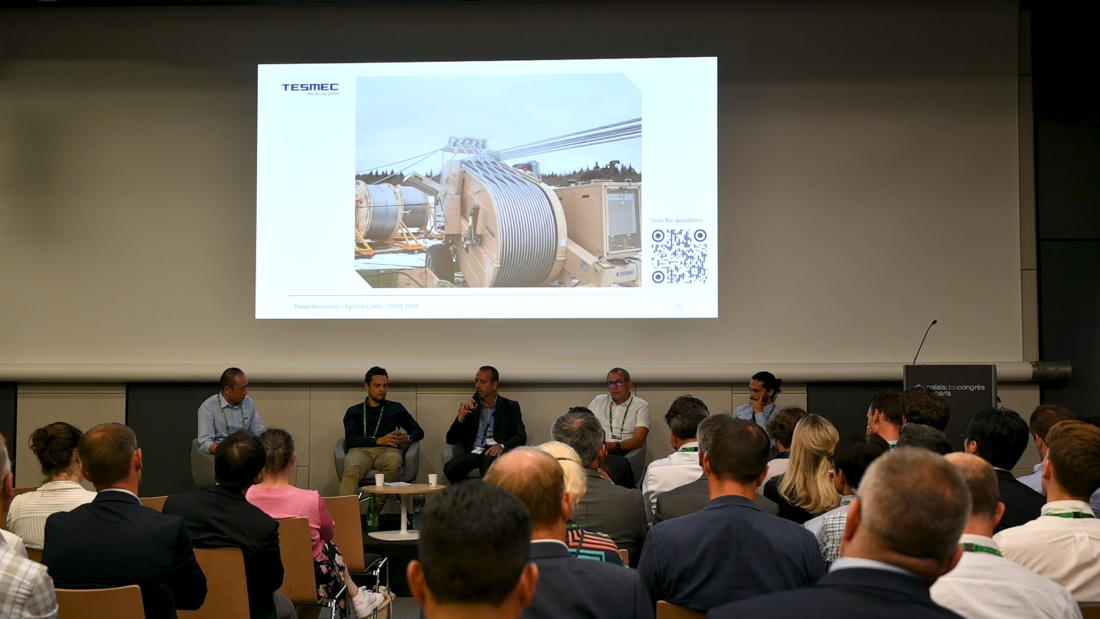
During the last CIGRE Paris Session, Epsilon Cable organized a panel discussion bringing together experts from utilities, engineering firms and manufacturers to exchange insights on composite core conductors. The event was fully booked, with around one hundred CIGRE delegates and guests, showing the strong interest this topic generates within the transmission community.
In this series of articles, we share key highlights of the event with a broader audience, in line with CIGRE’s mission to spread knowledge and best practices across the electrical transmission industry.
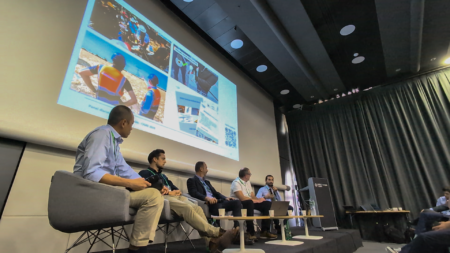
This second panel focused on the practical aspects of installing advanced conductors and featured:
- Tom Vanderlinden (Elia)
- Gianluca Cimmino (Tesmec)
- Jérôme Brocard (Sicame)
- Léo Richard (Epsilon Cable)
The session was moderated by Vincent Bu from Epsilon Composite.
In this episode, we focus on the evolution of installation tooling and stringing equipment for HTLS conductors, through the perspective of Tesmec.
Tesmec’s speaker: Gianluca Cimmino — stringing BU manager
Vincent Bu: How has the increasing deployment of advanced conductors influenced the development of stringing equipment and installation tooling?
Gianluca Cimmino: HTLS technologies have had a major impact on our industry over the last fifteen years. A very large share of the innovations developed for stringing equipment has been directly linked to the deployment of advanced conductors.
Compared with conventional ACSR conductors, HTLS conductors require much tighter control of bending radius and mechanical stresses during installation. This completely changed the way we design certain equipment and accessories.
Our objective has been to develop machines and tools that fully respect the physical limitations of these advanced materials during stringing operations.
Vincent Bu: Could you share some examples of the technical adaptations developed specifically for HTLS conductor installation projects?
Gianluca Cimmino: One of the main evolutions concerns bull wheel dimensions.
Twenty or twenty-five years ago, a 1200 mm bull wheel was considered large. Today, for some HTLS projects, we manufacture machines equipped with bull wheels reaching 2400 mm diameter in order to maintain a larger bending radius and reduce the risk of damaging the conductor during installation.
We also developed dedicated tooling solutions for specific projects. One example is the “array block” developed for Elia projects in order to manage very large equivalent conductor diameters that traditional blocks could not accommodate correctly.
Vincent Bu: What challenges are associated with protecting mid-span joints during stringing operations, and how have these been addressed?
Gianluca Cimmino: Traditionally, cover joints were difficult to use with composite core conductors because they could create excessive local bending angles on the conductor during pulling operations.
Together with Epsilon Cable, we developed an articulated cover joint system using swivel extremities in order to eliminate sharp bending points. The objective was to allow the joint to pass through the stringing blocks under safer mechanical conditions.
This solution also simplifies operations on site because the joint can be prepared directly at the tensioner and pulled through the line similarly to conventional conductors, which saves a significant amount of installation time.
Vincent Bu: What is your overall conclusion regarding the evolution of HTLS installation practices?
Gianluca Cimmino: The deployment of advanced conductors requires not only new conductor technologies, but also adapted installation methods and dedicated tooling. Today, the industry has gained much more experience with these technologies and installation practices are becoming increasingly mature. However, maintaining proper mechanical conditions during installation remains essential for long-term conductor reliability.