


- Home
- > Expert Insight
- > Conductor design
- > CIGRE Panel Session – Episode 5: Selecting the right composite core grade for sag and ice load conditions
CIGRE Panel Session – Episode 5: Selecting the right composite core grade for sag and ice load conditions
During the last CIGRE Session in Paris, Epsilon Cable organized a panel discussion bringing together experts from utilities, engineering firms and manufacturers to exchange insights on composite core conductors. The event was fully booked, with around one hundred CIGRE delegates and guests, highlighting the strong interest in this technology across the transmission community.
In this series of articles, we share key highlights from the event with a wider audience, in line with CIGRE’s mission to promote knowledge sharing and best practices within the electrical transmission industry.
The first expert panel featured:
- Erwin Platenkamp (TenneT)
- Jérémy Unterfinger (Amprion GmbH)
- Maxime Delbove (Nexans)
- Vivendra Naidoo (EFLA Consulting Engineers)
In this fifth episode, we explore the perspectives of a manufacturer and technical experts, as Maxime and Vivendra discuss how to select the right composite core grade for sag and ice load conditions.
The session was moderated by Joseph Sylvia from Epsilon Composite.
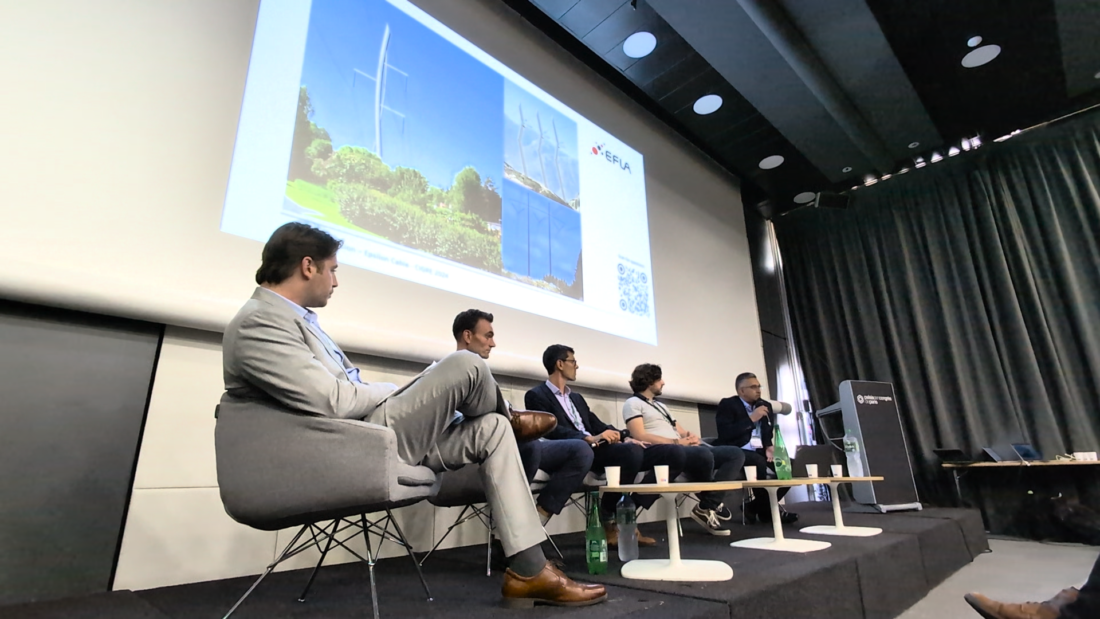
Joseph: Conductor elasticity is a major consideration during the design phase. Viven, could you tell us a little bit more about your thoughts on isolating design criteria for composite core conductors?
Viven: All of these ACSR composite core conductors have an initial tension of 60 N/mm², although actual tension values may vary. One important aspect to note with composite core conductors is that the modulus of elasticity can differ. A lower modulus of elasticity results in higher sag under ice loads, making the conductor behave almost like a rubber band. This obviously affects the external clearances of the line.
For any line designed up to about 7 kg/m of ice, the high-temperature operation of the conductor determines the external clearances. When the ice load exceeds 7 k/m, engineers determine the clearances based on the ice load, as conductor sag becomes greater than under maximum operating temperature. If you adjust the initial tension of the HTLS conductors to match that of the ACSR, the 7 kg/m reference point may drop to about 5 or 4 kg. When choosing an HTLS conductor to replace an ACSR, ideally you should select one with a modulus of elasticity very close to the ACSR conductor.
Another issue arises with a low modulus of elasticity. In broken wire conditions on suspension towers, additional strengthening of the towers may be required. The ACSR conductor acts almost like an anchor to prevent tower rotation under broken wire conditions. Increasing the tension on a lower-modulus conductor can solve this issue, but it introduces potential aeolian vibration problems that must then be addressed.
Joseph: Maxime, there are a few designs for high-capacity low-sag composite solutions available, with differences in their modulus of elasticity?
Maxime: Depending on the weather conditions of your overhead line, you need to select the proper core technology. You might choose hybrid composites or go for a full carbon fiber composite. Depending on your objectives, it is important to select the right core.
We have many possibilities depending on the project requirements. The key is to select the one that best fits the situation, as not all cores are compatible with every installation. This involves adjusting the quantity of carbon fibers and possibly using fibers with a higher modulus. Incorporating these fibers improves the overall modulus of elasticity of the carbon core.
Joseph: Viven, we consider line losses, but also CapEx. My understanding is that EFLA recently conducted a study on this. Could you share your findings and explain how they relate to our current discussions?
Viven: We were asked by Epsilon Cable to review their new “LITE” conductor design and evaluate what savings could be achieved using this new conductor. The HVCRC / ECRC conductor can be considered the standard design, while the new LITE conductor represents a more recent development. Both conductors have a similar architecture, with trapezoidal wires and a single composite core inside. However, the LITE conductor uses a core with a lower thermal rating, whereas HTLS conductors are designed to operate at higher temperatures.
We ran a simulation on a ten-kilometer section using a specific design code. Both conductors were tested at their full tension, assuming new lines were being installed. Pulling both conductors up to the maximum tension, we found that some savings could be realized.
The first, and most obvious, is in the span lengths: we could reach 490 meters with LITE instead of 200 meters with HVCRC / ECRC. The only notable change is in the C value, a common factor used to assess aeolian vibration, which increases slightly from the standard value of 1800 typically used for HVCRC / ECRC conductors, requiring slightly more damping in the system.
The main benefit is that spans could be 23% longer, allowing 15% fewer towers along the line.
This translates to around 12% savings on tower mass and approximately 11% less concrete used in the foundations. The conductor’s physical parameters are similar to those of the HVCRC / ECRC conductor, with the significant improvement being slightly lower losses, about 1.5% reduction.
The most notable impact, especially for helicopter-assisted construction, comes from the material savings: combining the steel saved in towers and the concrete saved results in roughly 168 tons of material. For projects using helicopters, this means around 163 fewer trips, assuming the common Squirrel B3 helicopter with a 1-ton lifting capacity.
Further studies are ongoing to evaluate the impacts if the tensions were kept the same as HVCRC / ECRC, such as in reconductoring projects, where savings are also expected.
It is interesting to see how a small composite core can have such project-wide implications. Another important point is that these conductors allow for lower tower heights, about 2.5 meters lower, which also has an aesthetic and environmental benefit.