


- Home
- > Expert Insight
- > Conductor design
- > CIGRE Panel Session – Epsiode 2 : Amprion’s return on experience on composite core conductors
CIGRE Panel Session – Epsiode 2 : Amprion’s return on experience on composite core conductors
During the last CIGRE Paris Session, Epsilon Cable organized a panel discussion bringing together experts from utilities, engineering firms and manufacturers to exchange insights on composite core conductors. The event was fully booked, with around one hundred CIGRE delegates and guests, showing the strong interest this topic generates within the transmission community.
In this series of articles, we share key highlights of the event with a broader audience, in line with CIGRE’s mission to spread knowledge and best practices across the electrical transmission industry. In the last episode, Erwin Platenkamp shared TenneT’s experience with composite core conductors.
The first expert panel focused on line design using composite core conductors and featured:
The session was moderated by Joseph Sylvia from Epsilon Composite.
- Erwin Platenkamp (TenneT)
- Jérémy Unterfinger (Amprion GmbH)
- Maxime Delbove (Nexans)
- Vivendra Naidoo (EFLA Consulting Engineers)
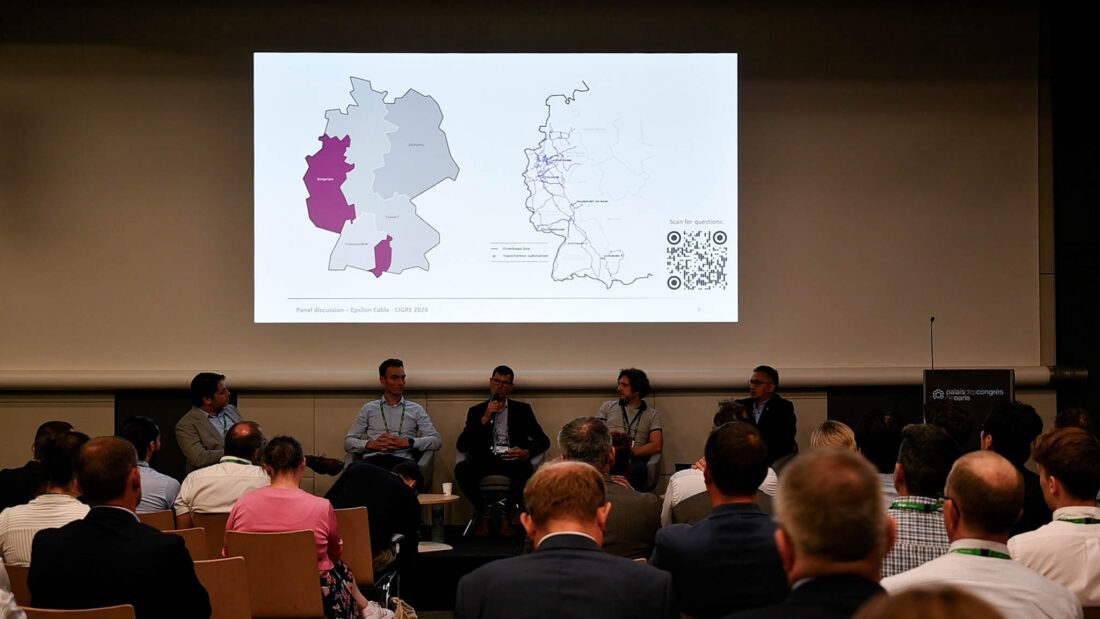
Next in our series is Amprion, one of Germany’s transmission system operators (TSOs).
Amprion Speaker: Jeremy Unterfinger – Head of Overhead Line Technology

Joseph Sylvia: Jeremy, could you tell us about Amprion?
Jeremy: Amprion is one of the four German transmission system operators (TSOs). Each TSO is responsible for a specific region, which is our controlled area, just like other TSOs worldwide. Our main responsibilities include planning and maintaining the network to ensure it remains in good condition, as well as guaranteeing its safety and stability.
We operate high-voltage and extra-high-voltage networks, specifically 220 kV and 380 kV lines in Germany. We also manage a few 110 kV lines, which are typically serving some direct clients.
Our region covers West Germany, home to 30 million people. We must ensure they receive the electricity they need to live and work.
Our network stretches from the North Sea to the Swiss border. It plays a crucial role in connecting Germany with the Netherlands, Belgium, France, and Switzerland, making it a vital network for interconnection and electricity transport within Germany.
What are the constraints your network is facing in Germany?
Jeremy: Germany has undergone significant changes due to the shift toward renewable energy. In 2015, energy production was located where energy was needed. However, with the rise of renewable energy, we must relocate production to areas with better weather conditions. To put it simply, we could say that wind energy is primarily in the north, while solar energy is in the south. While this is not entirely accurate, it gives a good general idea.
How does that influence electrical infrastructure?
Jeremy: This shift means that energy production is being relocated, while demand remains concentrated in the same areas. Between 2015 and 2045, there will be a significant change in the balance of where energy is required and where there is an excess of production. As a result, we need to build many new lines. German laws initially defined this in 2009 and 2014. Since then, we review and update our plans year after year to ensure we can transport electricity effectively by 2025.
In this context, which role are composite core conductors playing on your grid?
Jeremy: We need your PMC [Polymer Matrix Composites] core conductors at Amprion for three reasons.
The first one is that we need to refurbish our network and increase its capacity. Thanks to the very good CTE models, the thermal coefficient of expansion, we can replace our conductors with HTLS using a composite core without refurbishing the towers. The law in Germany changed last year, so we no longer need time-consuming authorizations. We can replace one core conductor with one HTLS conductor quickly. We want to use this technology to prepare our network for the future, even if very high currents are not needed today.
The second reason is noise reduction, and I will go into more details later.
The third point is the reduction of electrical losses. If you consider the resistivity of composite core conductors at standard operating currents, HTLS conductors have low losses. On the other hand, if you operate the conductor at 150°C, the air heats up and losses increase. So the key is how you assess it. This is important for current operations and should be considered for future projects, including new lines, not just refurbishment.