


- Home
- > Expert Insight
- > Conductor installation
- > CIGRE panel session — Episode 7: Elia’s return on experience on the installation of advanced conductors
CIGRE panel session — Episode 7: Elia’s return on experience on the installation of advanced conductors
During the last CIGRE Paris Session, Epsilon Cable organized a panel discussion bringing together experts from utilities, engineering firms and manufacturers to exchange insights on composite core conductors. The event was fully booked, with around one hundred CIGRE delegates and guests, showing the strong interest this topic generates within the transmission community.
In this series of articles, we share key highlights of the event with a broader audience, in line with CIGRE’s mission to spread knowledge and best practices across the electrical transmission industry.
This second panel focused on the practical aspects of installing advanced conductors and featured:
- Tom Vanderlinden (Elia)
- Gianluca Cimmino (Tesmec)
- Jérôme Brocard (Sicame)
- Léo Richard (Epsilon Cable)
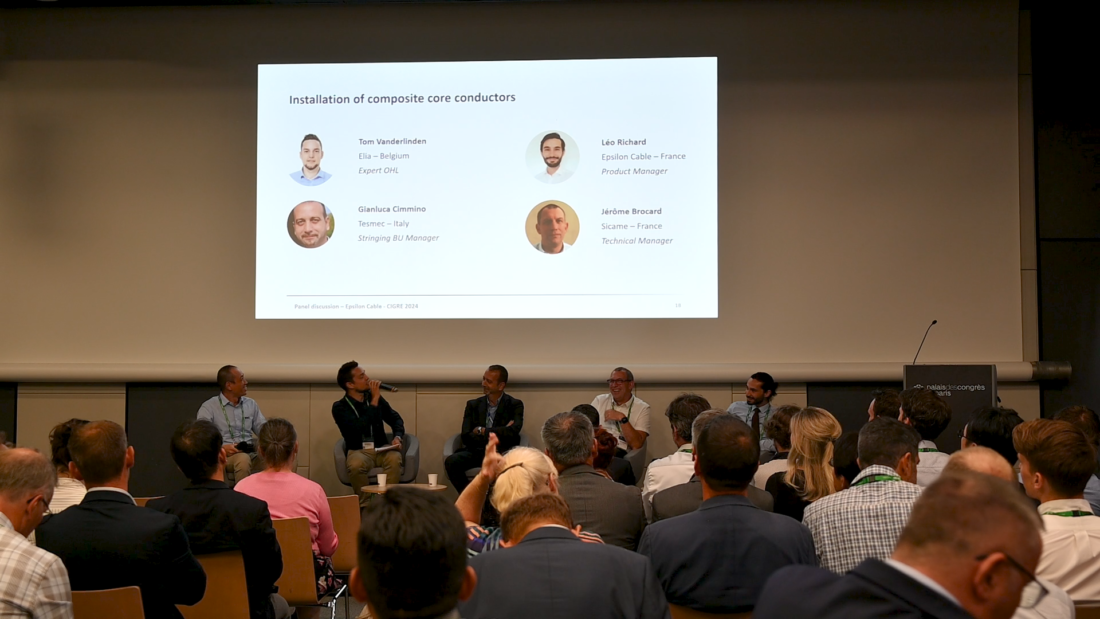
The session was moderated by Vincent Bu from Epsilon Composite.
In this episode, we focus on Elia’s operational feedback regarding the deployment and installation of composite core conductors on the Belgian transmission network.
Elia’s speaker: Tom Vanderlinden, overhead line expert
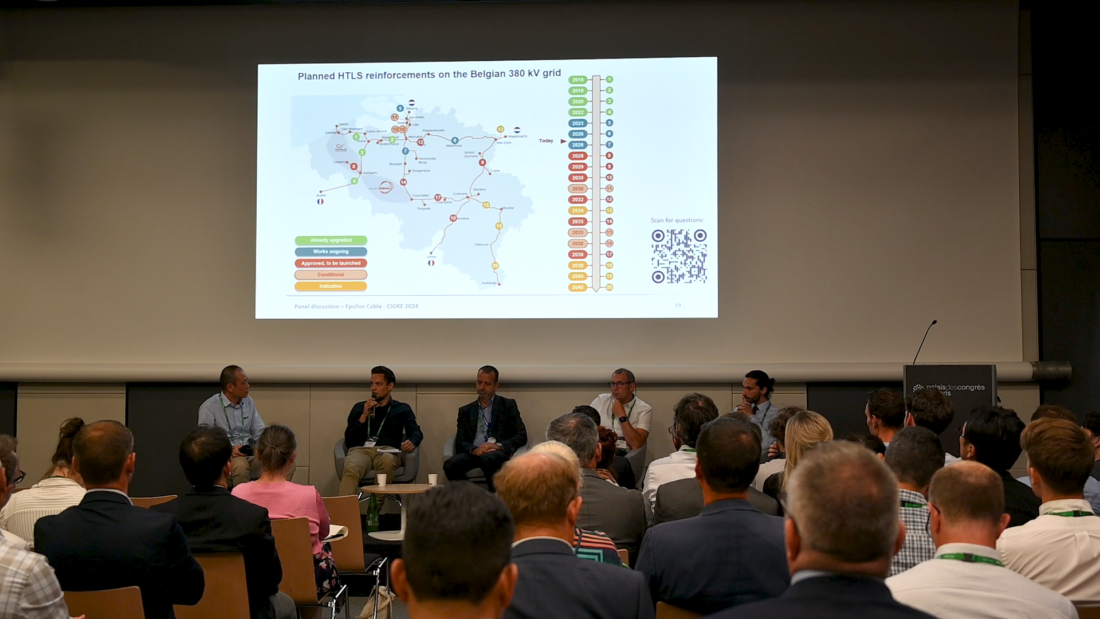
Vincent Bu: Could you provide an overview of Elia’s transmission network and explain the role advanced conductors currently play in your grid modernization strategy?
Tom Vanderlinden: Elia operates the Belgian transmission network from 70 kV up to 400 kV. Our 380 kV backbone was mainly built during the 1960s and 1970s and now requires major upgrades. Belgium is located at the center of the European interconnected grid, with strong interconnections to the Netherlands, France, Germany and the United Kingdom.
To support the energy transition and increasing electricity exchanges, we need to significantly increase transmission capacity on existing infrastructure. In some areas, the required increase can reach close to 100%.
For this reason, reconductoring existing lines with HTLS technologies has become one of our main strategies. Compared with building new lines, reconductoring is faster, more cost-effective and much easier from a permitting perspective.
Vincent Bu: How Elia’s experience with composite core conductors has evolved over the past years?
Tom Vanderlinden: We installed our first carbon core conductor in 2009, so we now have around fifteen years of operational experience with this technology.
Since 2012, Elia has been installing between 400 and 500 kilometers of advanced conductors every year. We remain open to different HTLS technologies depending on the project requirements, but composite core conductors are often particularly well adapted to our network constraints because they combine low weight with high mechanical performance.
This is especially important when existing towers have limited reserve mechanical capacity.
Vincent Bu: Based on Elia’s operational experience, what are the main lessons learned regarding the installation of composite core conductors?
Tom Vanderlinden: Installation quality is absolutely critical with composite core conductors. In 2018, we experienced a core failure, several years after installation. The investigation did not identify a single specific root cause, but the event clearly reinforced the importance of installation procedures, training and quality control in the field.
Composite core conductors require dedicated handling practices. For example, because the annealed aluminum layers are softer, we require the use of steel drums and stricter handling precautions during transport and stringing operations.
We also progressively introduced additional monitoring measures during installation. Today, we use camera monitoring during stringing operations and require integrity verification of the composite core after pulling operations.
Vincent Bu: How do you see the role of advanced conductors evolving within future European reconductoring programs?
Tom Vanderlinden: Advanced conductors are now an important part of our grid modernization strategy. The technology is mature, but long-term reliability depends heavily on installation quality and operational discipline in the field.
As reconductoring programs continue to accelerate across Europe, installation procedures, operator training and quality assurance will become increasingly important.