


- Home
- > Expert Insight
- > Conductor design
- > CIGRE Panel Session – Episode 3: HTLS conductor design and high-temperature behavior — Nexans and EFLA’s perspectives
CIGRE Panel Session – Episode 3: HTLS conductor design and high-temperature behavior — Nexans and EFLA’s perspectives
During the last CIGRE Paris Session, Epsilon Cable organized a panel discussion bringing together experts from utilities, engineering firms and manufacturers to exchange insights on composite core conductors. The event was fully booked, with around one hundred CIGRE delegates and guests, highlighting the strong interest in this technology across the transmission community.
In this series of articles, we share key highlights of the event with a broader audience, in line with CIGRE’s mission to spread knowledge and best practices across the electrical transmission industry. In the last episode, Erwin Platenkamp shared TenneT’s experience with composite core conductors.
The first expert panel featured:
- Erwin Platenkamp (TenneT)
- Jérémy Unterfinger (Amprion GmbH)
- Maxime Delbove (Nexans)
- Vivendra Naidoo (EFLA Consulting Engineers)
This third episode focuses on the viewpoints of a conductor manufacturer (Nexans) and an engineering firm (EFLA), offering complementary insights into conductor design choices and temperature-related considerations.
The session was moderated by Joseph Sylvia from Epsilon Composite.
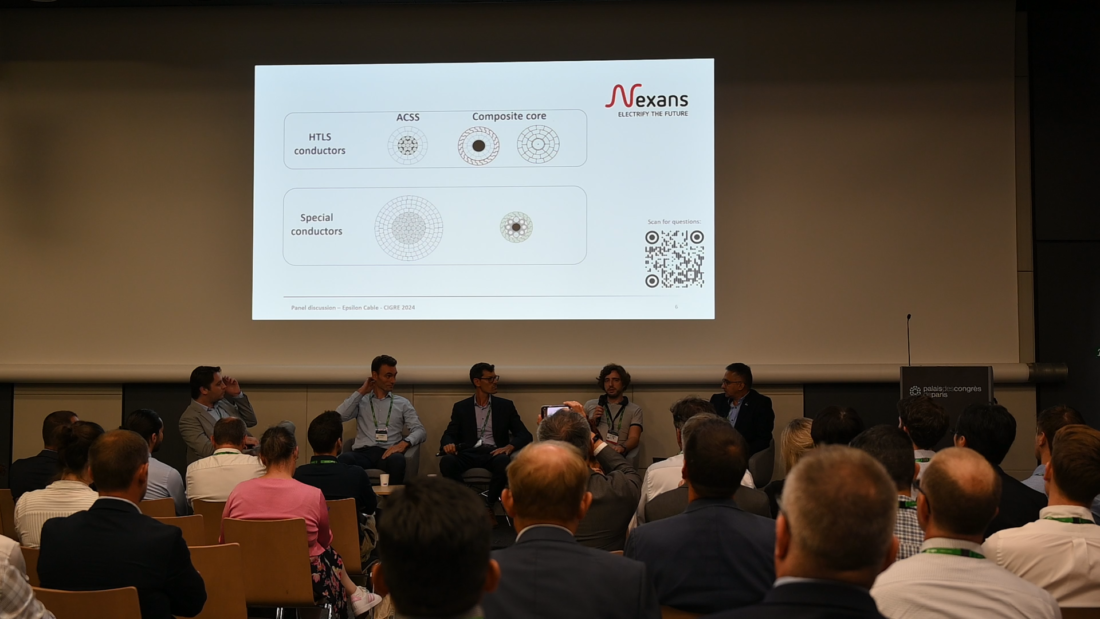
Joseph Sylvia: Maxime, could you tell us a little bit about Nexans, with a focus on the overhead line division?
Maxime Delbove: Nexans is a global company with around 28,000 employees operating in more than 70 countries. Today, however, I will focus specifically on the overhead line division.
Within the overhead line division, we do much more than produce standard conductors. Our ambition is to act as a solution provider and a designer of technical solutions that actively support the energy transition, especially in areas where grid constraints are the most critical.
We offer a broad portfolio of overhead line solutions, including high-temperature low-sag (HTLS) conductors and ACSS conductors. A key area of expertise for Nexans lies in conductors using carbon-fiber cores, whether hybrid carbon and glass fiber cores or full carbon fiber cores. In addition, we develop specific conductor designs for particular challenges, such as very large crossings or complex environmental conditions.
Joseph: Maxime, from a manufacturer perspective when we look at high temperature and loadings needs from the grid, what materials do you recommend?
Maxime: Selecting the material begins with knowing the operating temperature of the conductor. The choice of material differs depending on whether the conductor operates at low temperatures, below 90°C, or high temperatures, above 90°C.
For standard applications and a wide range of temperatures, engineers use pure aluminum as well as 6000-series alloys that combine aluminum, magnesium, and silicon. These alloys are well known across the industry.
When it comes to high-temperature applications, there are two main approaches. The first is to heat-treat or anneal pure aluminum, allowing it to operate at higher temperatures. The second is to use a special type of alloy, such as aluminum-zirconium, which is a heat-resistant alloy. By adding a small amount of zirconium, the conductor gains thermal stability, enabling it to operate within a range of 210°C to 230°C for short periods.
However, selecting the right aluminum material is only part of the process. It is also essential to choose a compatible material for the core. For ACSS conductors, it is important to pick the suitable steel grade. For composite cores, the correct composite material must be chosen to ensure optimal performance.
Joseph: When we think high temperature, we think losses. That is why sometimes we say high capacity low sag as opposed to high temperature. With this in mind, do you have any design considerations to reduce temperature, and therefore reduce line losses?
Maxime: The first mistake to avoid is thinking you can achieve low losses at high temperature, which is not compatible. When we talk about low-loss conductors, we refer to standard losses. However, having a conductor capable of operating at high temperature is necessary for peak loads, when a lot of power must flow across the network or large loads are present. Otherwise, the air around the conductor heats up, which is not the purpose of the line.
In terms of design, the first key is to have a very compact structure, putting the maximum amount of aluminum in the minimum volume, while respecting all constraints regarding median diameter for noise or wind pressure, and considering weight to ensure that the towers can support the HTLS line loads. This is essential: maximizing aluminum content to reduce losses.
The second key is optimizing the quality of the alloy used, controlling heat treatment, and knowing what can be achieved, aiming to exceed standard requirements whenever possible. The goal is always to push the limits with the technology available today, mastering the quality of the product used and optimizing performance.
Question from the audience: Considering how compact the trapezoidal strands are in comparison with stranded one, is heating an issue on the conductors and how would that impact the losses?
Jeremy Unterfinger: To take an example, a conductor with round wire has 265 mm² of aluminium cross section but a conductor with trapezoidal wires of the same diameter will have a cross section of 300 to 330 mm². This means a better resistivity. And if you are passing the same current, the conductor with trap wires will run 20-30 degrees cooler. So actually it’s cooling your conductor to have more aluminium.
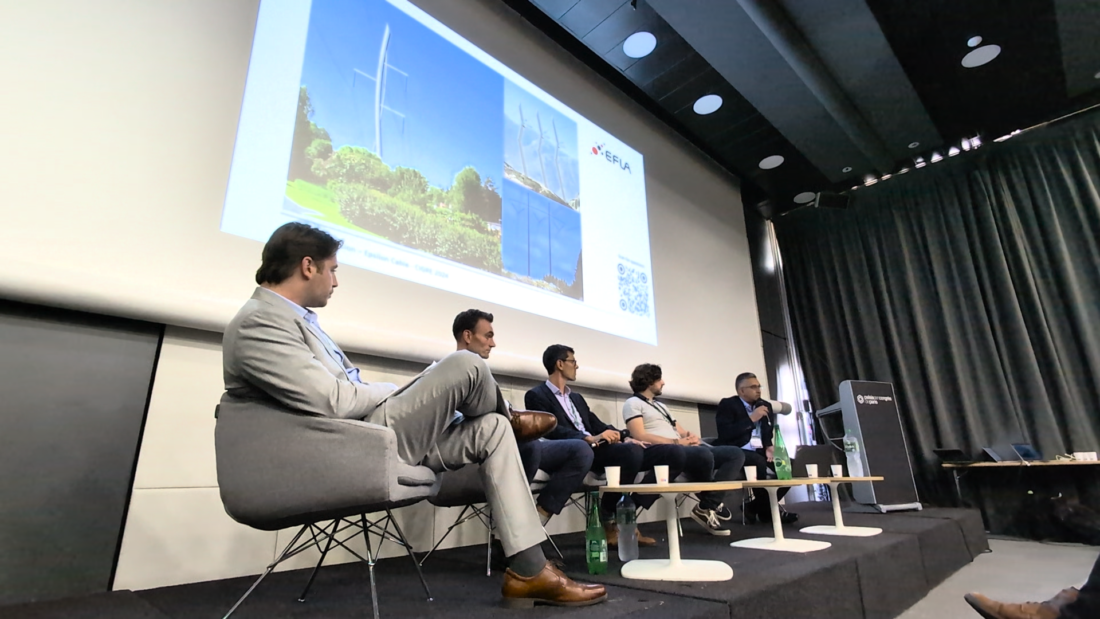
Joseph Sylvia: Vivendra, could you tell us a little bit about EFLA?
Vivendra: EFLA is a multidisciplinary engineering company headquartered in Iceland. We employ around 500 engineers, many of whom work internationally across six countries, with expertise covering power line design and substation design. Overall, the company operates in seven European countries.
In the overhead line sector, we mainly support major transmission system operators in countries such as Norway, Iceland, Sweden, Germany, and France. One of EFLA’s core strengths is structural design under heavy ice load conditions, particularly for transmission towers. In fact, our first tower design dates back to 1980, well before tower design became a widely discussed topic in the industry.
Joseph Sylvia: From a consultancy standpoint, could you share your perspective on conductor temperature behavior throughout the day?
Vivendra: When it comes to conductor temperatures, utilities typically apply very strict criteria. Unless fiber optic sensors are installed in the phase conductors or real-time monitoring systems are used, temperature calculations must rely on deterministic assumptions.
With HTLS conductors, one critical aspect is the temperature difference between the core and the outer aluminum layers. Standards and methodologies, such as those described in CIGRE Technical Brochure C27, provide equations for calculating conductor temperature. However, special attention is required when materials are involved whose mechanical performance may deteriorate at elevated temperatures.
This is particularly relevant for conductors with loose aluminum strands. Due to the temperature gradient between the core and the outer layers, the aluminum can begin to loosen under low tension as current density increases. As a result, electrical conductivity decreases with rising temperature, and the temperature difference between the core and the outer layer can reach up to 20°C. From a utility perspective, it is therefore essential to carefully review conductor specifications and to clearly understand how manufacturers calculate conductor temperatures. Knowing how ampacity has been assessed and what temperature difference is allowed between the core and the outer layer is key to ensuring the long-term mechanical and electrical performance of the conductor.