


- Home
- > Actualites
- > Introducing HVCRC® LITE
Introducing HVCRC® LITE
Through a dedicated series of posts on LinkedIn, we presented HVCRC® LITE, a breakthrough conductor that challenges the conventions of HTLS design.
Each episode highlights a key aspect of this new patented conductor type: from its unique technical positioning to real-world performance and cost-saving potential.
Episode 1 – How can a composite core conductor NOT be an HTLS?

What if you didn’t have to pay for performance you don’t need? HVCRC® LITE retains all the structural advantages of a composite core (lightweight, high strength, low sag, no thermal expansion) but is designed for standard operating temperatures (up to 90°C, or above as an option), just like traditional ACSR conductors.
By removing the high-temperature requirement, it cuts costs by about 50% compared to HTLS conductors while maintaining key benefits such as lower sag and reduced energy losses. HVCRC® LITE is the smart choice when extreme temperatures aren’t necessary, delivering performance where it matters without the HTLS price tag.
Episode 2 – Reducing construction cost and lead time
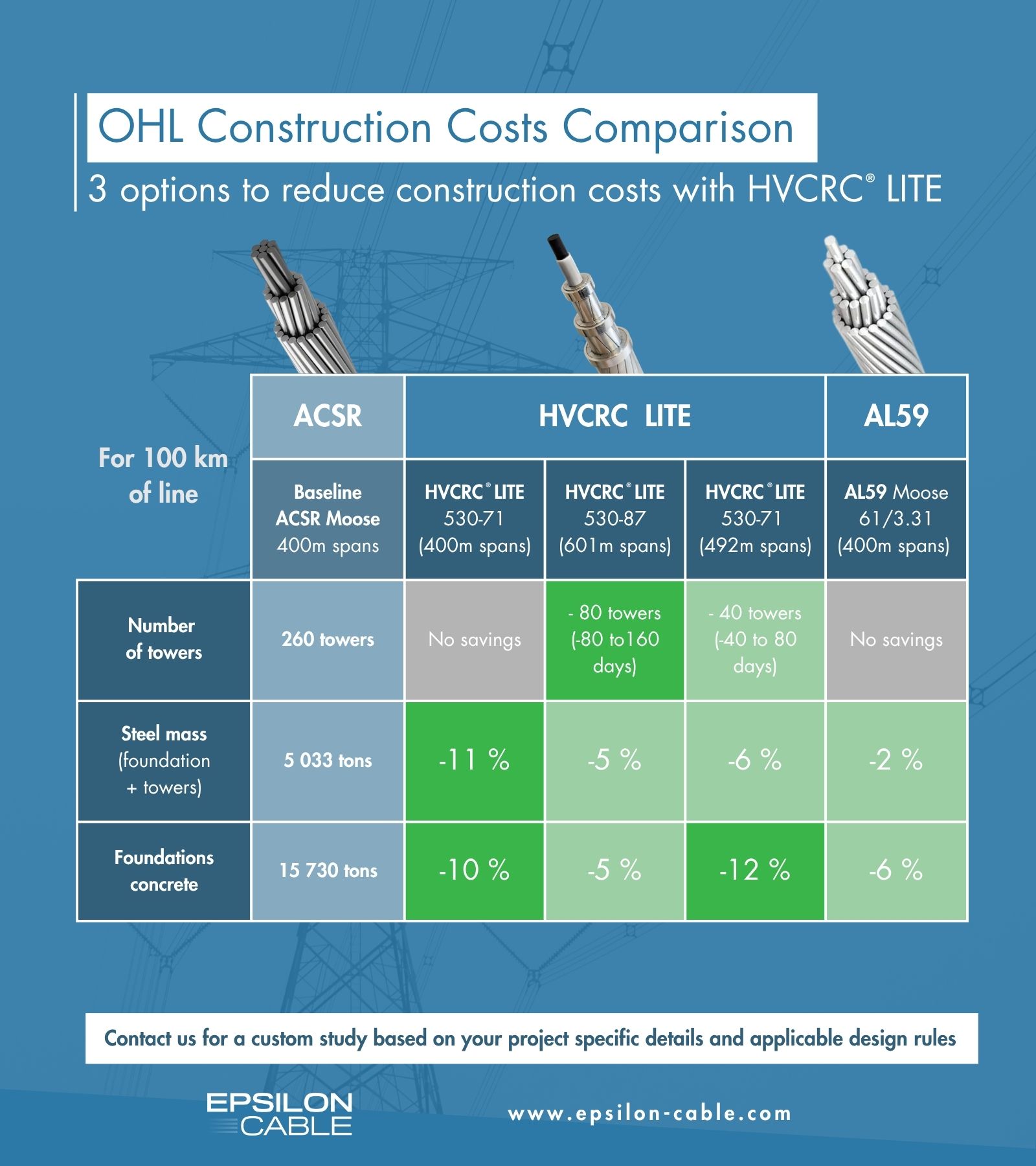
Episode 2 explores how HVCRC® LITE helps optimize project costs and timelines.
An independant study by EFLA Consulting Engineers on a 400 kV line (based on IS 802:2015) compared ACSR, Al59, and three HVCRC® LITE configurations. The results showed major savings: fewer towers, lighter structures, and shorter project duration (up to 160 days saved).
Despite a slightly higher conductor price, overall project savings ranged from 5 to 10%. Whether by reducing tower count, foundation volumes, or both, HVCRC® LITE enables smarter, faster, and more cost-effective grid expansion.
Episode 3 – Case study: Reducing electrical losses with HVCRC® LITE

In this third episode, we focus on the electrical efficiency gains enabled by HVCRC® LITE when used in new transmission lines. Compared to traditional metallic conductors like ACSR or AAAC/Al59, HVCRC® LITE achieves a 25% reduction in electrical losses.
When offsetting this benefit against the slightly higher initial investment in the conductor itself (without even factoring in the structural savings highlighted in Episode 2) the return on investment is impressive. The payback period drops below 3 years, and the long-term financial gains more than double those of an Al59 solution.
Calculations show that while HTLS conductors like HVCRC® remain relevant for new lines requiring high-temperature operation, they involve an upfront cost around 30% higher than ACSR, with a payback period of more than 6 years.
HVCRC® LITE stands out as the most cost-efficient solution for new overhead lines where extreme temperature resistance is not needed, delivering strong performance, fast ROI, and long-term energy savings.